
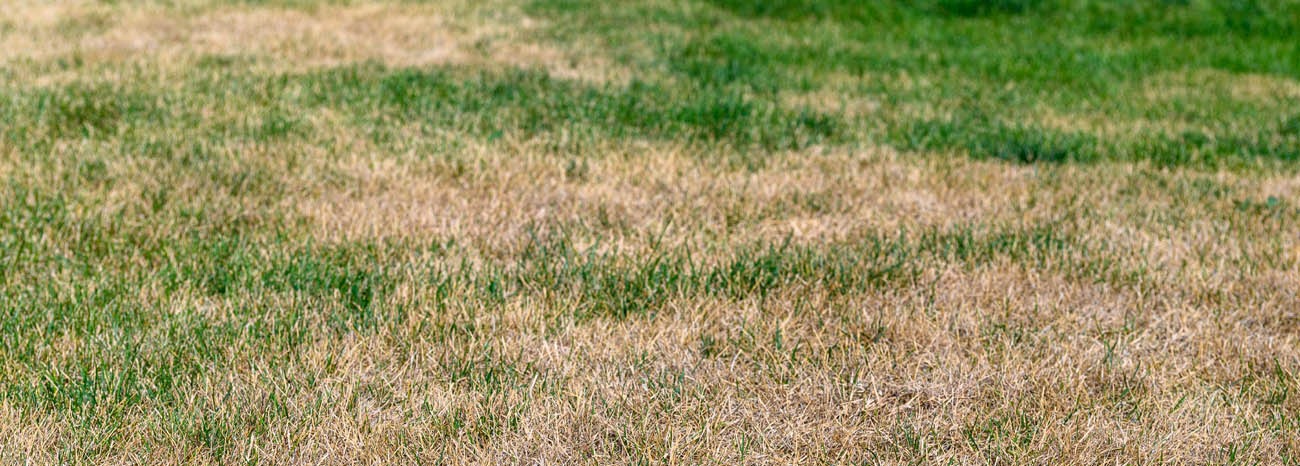
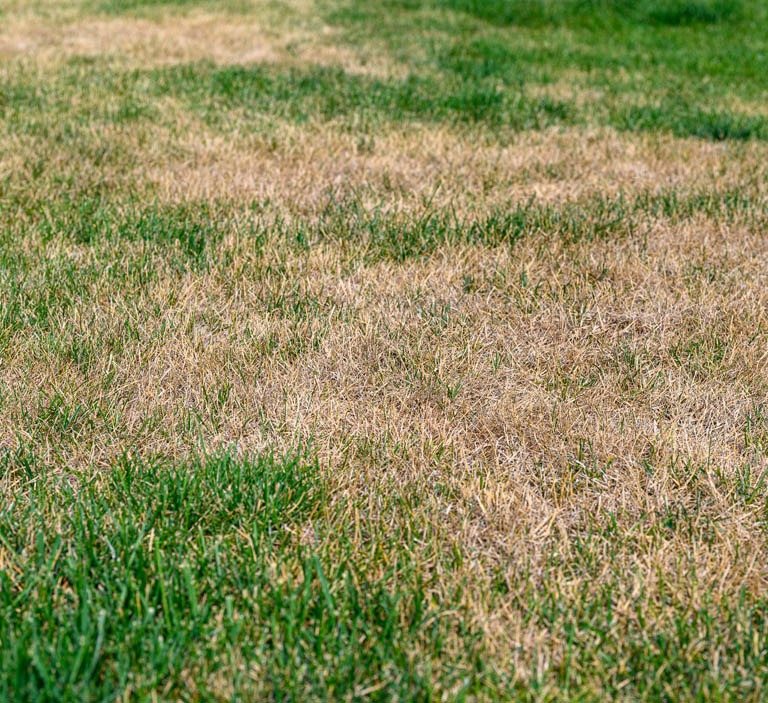
Brown patches on a lawn in July or August usually come from one of four causes: drought stress from insufficient watering, dormancy from heat and dry conditions, disease or pest damage, or physical stress from foot traffic and soil compaction. The fix depends on which cause you’re dealing with, and the first step is always diagnosis. Moyer Indoor Outdoor has treated brown lawns across Bucks, Montgomery, and Delaware counties since 1869, and the pattern is consistent: a browning lawn is a lawn communicating that something is out of balance. This guide walks through how to identify what’s actually wrong with your lawn, how to fix each of the common causes, and how to prevent brown patches from returning next season.
Why is my lawn turning brown?
Cool-season lawns in Pennsylvania and the Delaware Valley (tall fescue, Kentucky bluegrass, ryegrass) evolved to thrive in spring and fall, when temperatures are moderate and rainfall is consistent. When July and August arrive with 90-degree days, weeks between rain events, and hot dry winds, these grasses are outside their comfort zone. Browning is often the visible result.
Drought stress and dormancy are the leading causes of summer browning in southeastern Pennsylvania. When soil moisture drops and rainfall stops for weeks, cool-season grasses first develop drought stress (wilting, color change, reduced growth), then enter dormancy as a survival mechanism. A dormant lawn looks dead but usually recovers when water returns.
Watering problems cause more browning than most homeowners realize. Overwatering drowns roots, encourages fungal disease, and produces brown patches that look similar to drought damage. Underwatering during heat waves leaves grass without enough moisture to sustain itself.
Lawn diseases including brown patch, dollar spot, red thread, leaf spot, and pythium all thrive in the hot, humid conditions of southeastern Pennsylvania summers. Each produces a distinctive pattern of browning.
Pests including white grubs and chinch bugs feed on grass roots or blades. Grub-damaged turf lifts easily like a loose carpet and often has visible animal damage where birds, skunks, or raccoons have been digging for the grubs.
Nutrient deficiencies and soil pH problems produce gradual, uneven browning. Nitrogen deficiency shows as pale yellowing before it browns. Low soil pH (below 6.0 for cool-season grasses) reduces nutrient uptake even when fertilizer is applied.
Foot traffic and soil compaction create brown paths along walking routes, mowing lines, and play areas. Compacted soil blocks water, air, and nutrients from reaching the roots.
Extreme heat combined with reflected heat from driveways, patios, and south-facing walls can bake grass in specific areas even when the rest of the lawn is fine.
Dead grass or dormant grass? Confirm before you treat.
Before you spend money treating a browning lawn, confirm that the grass is actually dead. Cool-season lawns in the Delaware Valley go dormant during summer heat and drought, and dormant grass looks nearly identical to dead grass: tan, dry, and crunchy. The difference matters because dormant grass revives when temperatures cool and rainfall returns, while dead grass has to be replaced.
The pull test takes ten seconds. Grab a handful of the tan grass and pull firmly. If the roots hold and require real effort to pull up, the grass is dormant, and you can help it recover by watering deeply and waiting for cooler weather. If the grass pulls up easily with the roots intact, the grass is dead and the area will need reseeding or sodding.
EPA WaterSense confirms that seasonal browning is normal: it’s healthy for a lawn to turn a little brown during the hottest summer months as it goes dormant. If your entire lawn browns during a heat wave, that’s likely dormancy, not death. Larger brown areas with irregular, expanding edges point to disease or pest activity rather than dormancy. Symmetrical browning along a fence line, driveway, or south-facing wall usually points to reflected heat or edge dryness.
Drought stress: what it looks like and why it happens
Drought stress happens when your lawn is growing but doesn’t have enough water to sustain itself. Water uptake slows, growth stops, and the grass shows the first warning signs before entering full dormancy. Catching drought stress early gives you the opportunity to correct it before the lawn browns significantly.
The earliest signs of drought stress:
- Wilting and curling grass blades. Individual blades fold along the length rather than standing upright. Under close inspection, the blades feel dry and papery rather than turgid.
- Color shifts before browning. Cool-season grasses under drought stress often turn blue-gray or purple-gray before browning. This is a distinct color and easier to catch than looking for brown patches.
- Footprints and mower tracks that stay visible. Healthy grass springs back after being walked on. Drought-stressed grass holds the imprint of footprints, mower wheels, and pet paths for hours. This is one of the most reliable early warning signs.
- Hard, hydrophobic soil. In severe drought, soil dries so completely that it repels water when it does finally rain. Water runs off the surface instead of soaking in. If you can’t push a screwdriver more than an inch into your lawn’s soil, it’s severely dry.
If drought conditions continue, the lawn enters dormancy: growth stops, color fades to tan, and the grass conserves resources by shutting down its above-ground activity. Roots remain alive and can survive several weeks of dormancy in a healthy lawn. Prolonged drought beyond that point causes drought damage, which is not the same as drought stress. Drought damage means grass has actually died, and those areas will need to be reseeded even after conditions improve.
Pennsylvania has entered periodic drought watch and drought warning status in recent years, most recently in 2025 and 2026, when the state Department of Environmental Protection declared drought conditions across dozens of counties. When your county is under a drought watch, water utilities may request voluntary conservation of 5 to 15 percent, which affects how much you can water your lawn without violating restrictions. Check the current Pennsylvania drought status through the state DEP if you’re planning significant lawn watering during a dry summer.
Watering practices that fix a browning lawn
More lawn browning is caused by watering mistakes than by any other single factor. Both overwatering and underwatering create brown patches, and the two look similar enough that homeowners often make the wrong correction.
The one-inch-per-week rule. Cool-season lawns in southeastern Pennsylvania need approximately one to one and a half inches of water per week during the growing season, delivered in one or two deep watering sessions rather than daily light watering. This total includes rainfall. Deep, infrequent watering pushes roots down into the soil, where they can access moisture reserves during dry stretches. Frequent light watering keeps roots shallow, right where the soil dries out fastest.
Does overwatering cause brown patches? Yes. Overwatered lawns develop three problems that all produce browning. First, saturated soil drowns roots by depriving them of oxygen. Second, constant moisture on grass blades and thatch creates ideal conditions for fungal diseases like brown patch and pythium. Third, overwatering keeps roots shallow, which paradoxically makes the lawn less drought-tolerant. If a section of your lawn feels spongy underfoot and has irregular brown patches with darker borders, overwatering may be the cause.
How to check whether your lawn actually needs water. Push a long screwdriver or a soil probe into the ground. If it slides in at least six inches with modest pressure, soil moisture is adequate. If it stops short or requires significant force, your lawn is dry and needs water. This test is more reliable than a calendar-based watering schedule.
When to water. Early morning (between 4 a.m. and 9 a.m.) is optimal. Water evaporates less in cooler morning temperatures, wind is usually calmer, and the grass blades dry before evening, which reduces fungal disease risk. Evening watering leaves blades wet overnight and invites disease. Midday watering wastes 20 to 30 percent of the water to evaporation.
Irrigation audit for automatic systems. Sprinkler systems that were installed correctly can drift out of adjustment over time. Heads clog, arcs shift, and pressure changes. The simplest audit places identical containers (empty tuna cans work well) across each irrigation zone and runs the system for a fixed period. Water depth in each container should be similar. Zones with significantly less water indicate coverage problems that need adjusting. EPA WaterSense recommends this audit at the start of each irrigation season.
Weather-based irrigation controllers and soil moisture sensors are efficiency upgrades worth considering. WaterSense-labeled weather-based controllers use local weather data to skip watering days when rain has occurred or is coming, potentially saving thousands of gallons per year for a typical household while keeping the lawn healthier.
When your area is under a drought watch or warning, reduce lawn watering to the minimum needed to keep the crown of the grass plant alive (typically half an inch per week rather than the standard 1 to 1.5 inches). A dormant lawn will recover; a dead lawn will not. Prioritize water for trees and shrubs over turf during severe drought.
Nutrient deficiencies and soil pH problems
A browning lawn that never quite responds to watering is often a soil problem. Cool-season grasses need adequate nitrogen for green color, sufficient potassium for stress tolerance, and a soil pH in the range of 6.0 to 7.0 to absorb nutrients efficiently.
Nitrogen deficiency shows as pale yellow-green color across the whole lawn before it browns. The lawn grows slowly and thins out over time. Correction is straightforward: a balanced fertilizer application on a schedule matched to your grass type. Cool-season lawns benefit from fertilization roughly every six to eight weeks during the growing season.
Potassium deficiency doesn’t always produce visible color changes but leaves grass less resilient to heat, drought, and disease. Lawns with adequate nitrogen but low potassium may look reasonably green in spring but brown quickly under summer stress.
Iron deficiency produces distinctive yellowing on the newest leaves while older leaves stay green. Common in high-pH soils. Not usually a browning cause on its own but weakens the lawn’s response to other stresses.
Low soil pH (acidic soil) is the most common underlying issue in southeastern Pennsylvania. Native soils here trend acidic, and cool-season grasses don’t absorb nitrogen efficiently below pH 6.0. A soil test measures pH along with nutrient levels and takes the guesswork out of correction. Penn State Extension provides soil testing services through their Agricultural Analytical Services Laboratory, and soil test kits are available through county extension offices for a modest fee. If your soil pH is low, a lime application raises it to the optimal range and improves the effectiveness of any fertilizer you apply.
If you’ve been fertilizing consistently and your lawn still browns quickly under summer stress, test your soil before applying more fertilizer. More fertilizer on already-nutrient-adequate soil won’t fix the actual problem and can burn the grass.
Pests and disease as browning causes
Not every brown lawn is a watering problem. Pests and disease produce distinctive browning patterns that experienced eyes can identify from the shape and spread of the affected areas.
- Grub damage shows as irregular brown patches that expand over a few weeks in mid to late summer. The most diagnostic sign is turf that lifts easily like carpet: grubs eat the roots, so damaged sections detach from the soil. Animal activity (birds, skunks, raccoons digging in the lawn) confirms grub presence. Peel back a suspicious patch and look for white, C-shaped larvae in the top inch of soil. Ten or more grubs per square foot warrants treatment.
- Brown patch disease produces roughly circular brown areas ranging from a few inches to several feet across, often with a darker “smoke ring” border visible in early morning dew. Common in hot, humid weather following extended wet periods. Cool-season grasses, tall fescue especially, are highly susceptible.
- Dollar spot creates small (silver-dollar-sized) brown or straw-colored patches that may merge into larger irregular areas. Appears in early morning as a whitish, cobweb-like fungal growth on affected blades.
- Red thread produces pink or reddish tinges on grass blades in small patches, especially in cool wet weather. Nitrogen deficiency often makes it worse.
- Leaf spot and pythium are additional summer disease pressures that require accurate identification for correct treatment. If your lawn shows brown patterns you can’t attribute to watering, drought, or pests, professional diagnosis is worth the visit. A lawn technician can identify most common diseases visually and recommend appropriate treatment.
- Chinch bugs feed by sucking sap from grass blades, causing yellow patches that turn brown as the damage progresses. Most severe in hot, dry weather. Chinch bug damage often gets misdiagnosed as drought stress because the timing overlaps and both produce browning in hot weather.
Foot traffic and soil compaction
Brown paths that follow walking routes across the yard, mowing lines around garden beds, and children’s play areas usually point to soil compaction rather than any of the causes above. Compacted soil blocks water infiltration, restricts root growth, and prevents oxygen from reaching the root zone.
Compaction correction requires mechanical intervention: annual core aeration, which pulls small plugs of soil out of the lawn and creates channels for water, air, and nutrients to reach the roots. Aeration is most effective in early fall for cool-season lawns, when it can be paired with overseeding to fill in the thin areas that compaction has created.
For areas that receive heavy foot traffic year after year, permanent stepping stones or a mulched path can eliminate the underlying cause. Rerouting mowing patterns can spread the wear across more of the lawn instead of concentrating it in a single line.
Repairing damage: reseeding and sodding
Once the underlying cause has been addressed, areas of actual dead grass need to be replaced. Bare patches don’t fill in on their own; surrounding turf grows outward slowly, and weeds usually establish faster than the desired grass does.
Small patches (less than a square foot) can often be spot-repaired. Rake out the dead grass, loosen the top inch of soil, spread seed matched to the surrounding lawn, cover lightly with soil or straw, and water lightly two or three times a day until seedlings establish.
Larger patches benefit from full-service overseeding, which pairs aeration with seeding across the affected area. For cool-season lawns in southeastern Pennsylvania, mid-August through mid-September is the optimal overseeding window. Spring is the second-best window, though seed sown in spring has to survive its first summer without a fully developed root system.
Extensive damage (more than 25 percent of the lawn) may warrant sodding for faster coverage. Sod is grass grown to maturity elsewhere, harvested with the root mat intact, and laid down like a carpet. Cost is higher than seed but the lawn looks finished immediately, which matters for slopes prone to erosion or for homeowners who need coverage before an event.
Detailed guidance on both approaches, including when to choose each and step-by-step process, is in our companion guide to fixing dead grass and bare spots.
Preventing browning: a year-round healthy-lawn approach
Most lawn browning is preventable through consistent seasonal maintenance. The healthiest lawns don’t just survive summer; they enter summer with the reserves to handle it.
Spring is for setting up summer resilience. Apply lime if soil pH is low. Apply pre-emergent crabgrass control by early April in southeastern Pennsylvania. Begin the fertilization schedule. Mow at three inches or slightly higher, and never remove more than one-third of the blade in a single mowing.
Early summer shifts the focus to watering discipline. Establish the deep-and-infrequent schedule (one to one and a half inches once or twice a week) rather than daily light watering. Raise mowing height to 3.5 to 4 inches; longer grass shades its own root zone and holds soil moisture better.
Mid to late summer is when browning problems appear. Continue disciplined watering, monitor for disease, and accept some browning as normal dormancy rather than fighting it with excessive water. A brief dormant period is normal for cool-season grasses and doesn’t harm a healthy lawn.
Early fall is the most important window of the entire lawn care year. Aerate compacted soil. Overseed thin areas. Apply the fall fertilization. This is when the lawn recovers from summer stress and builds root reserves for next year. A strong fall program is the single best insurance against next summer’s browning.
Late fall brings the final fertilization of the year (roughly late October to mid-November). This application supports root growth after top growth has slowed, and it’s the fuel the lawn draws on for next spring’s green-up.
Winter is generally a rest period, but heavy foot traffic on dormant grass can cause damage that shows up as brown patches when spring arrives. Reduce winter traffic on the lawn, especially when it’s frozen or covered with snow.
The lawns that hold their color through August and September are almost always the lawns that received attention in September and October of the previous year. Prevention starts nine months before the problem appears.
When to call a professional
Professional lawn care is worth the cost when browning is extensive, persistent, or difficult to diagnose. Specifically:
- Browning affects more than 25 percent of the lawn and you’re not sure of the cause
- You’ve corrected watering and the browning continues
- The browning pattern looks like disease or pest damage and you need accurate diagnosis before treatment
- Repeated summers have produced browning despite your best DIY efforts
- Your lawn is under an active irrigation system that isn’t producing consistent results
- You want a soil test with interpretation and a matched-to-your-conditions treatment plan
Moyer Indoor Outdoor’s lawn care team serves homes and businesses across Bucks, Montgomery, Chester, Lehigh, and Delaware counties in Pennsylvania. Our licensed technicians can diagnose browning from any of the causes covered above, apply targeted treatments matched to your specific lawn conditions, and set up a seasonal program that prevents repeat problems.
Call (215) 799-2016 or schedule an evaluation online at emoyer.com/services/lawncare/.
Frequently asked questions
Why is my lawn turning brown in the summer?
The most common cause is drought stress or dormancy from insufficient water combined with summer heat. Other causes include overwatering (which drowns roots and encourages disease), lawn diseases like brown patch and dollar spot, grub damage, nutrient deficiencies, or soil compaction from foot traffic. Diagnosing the specific cause is the first step to fixing it.
Does overwatering cause brown patches?
Yes. Overwatering saturates the soil, deprives roots of oxygen, encourages fungal diseases, and creates shallow roots that make the lawn less drought-tolerant. Overwatered brown patches often feel spongy underfoot and have darker borders. If your lawn is browning despite regular watering, check whether you might be overwatering before adding more.
Is my lawn dead or dormant?
Pull a handful of the browning grass firmly. If the roots hold and require real effort to pull up, the grass is dormant and will recover when conditions improve. If it pulls up easily with the roots intact, the grass is dead and will need reseeding.
How much water does my lawn need in summer?
Cool-season lawns in Pennsylvania need approximately one to one and a half inches of water per week, including rainfall, delivered in one or two deep waterings rather than daily light watering. Deep, infrequent watering encourages roots to grow deeper and makes the lawn more drought-tolerant.
When should I water my lawn?
Early morning between 4 a.m. and 9 a.m. is optimal. Cooler temperatures reduce evaporation, wind is usually calm, and grass blades dry before evening, which reduces disease risk. Avoid evening watering.
What does drought stress look like on a lawn?
Early signs include wilting or curling grass blades, a blue-gray or purple-gray color shift before browning, footprints and mower tracks that stay visible instead of springing back, and hard soil that repels water. Catching these signs early gives you a chance to correct the problem before the lawn browns significantly.
Will my brown lawn come back?
Dormant lawns almost always recover when cooler weather and consistent moisture return, usually within two to three weeks of improved conditions. Dead grass will not recover and needs to be reseeded or replaced with sod. Use the pull test to distinguish which you’re dealing with.
How do I fix brown patches in my lawn?
Diagnose the cause first, since fixes differ. For drought and dormancy, water deeply and wait for cooler weather. For overwatering, reduce watering and improve drainage. For pests or disease, apply targeted treatment. For dead patches, rake out the dead grass, loosen the soil, spread seed matched to the surrounding lawn, and water lightly until established. Larger areas may need aeration paired with overseeding, best done in early fall.
Can I mow a brown lawn?
Mow only if the grass is actually growing. If growth has stopped due to drought dormancy, mowing adds stress without benefit. When you do mow a stressed lawn, raise the blade to the highest setting (3.5 to 4 inches for cool-season grasses) and mow in the early morning or evening.
What’s the best long-term fix for a lawn that browns every summer?
Address the root causes in the previous fall. Aerate compacted soil, overseed thin areas, apply lime if soil pH is low, and complete the fall fertilization program. Lawns that receive attention in September and October are almost always the lawns that hold their color through the following summer.
Updated: September 22, 2026