
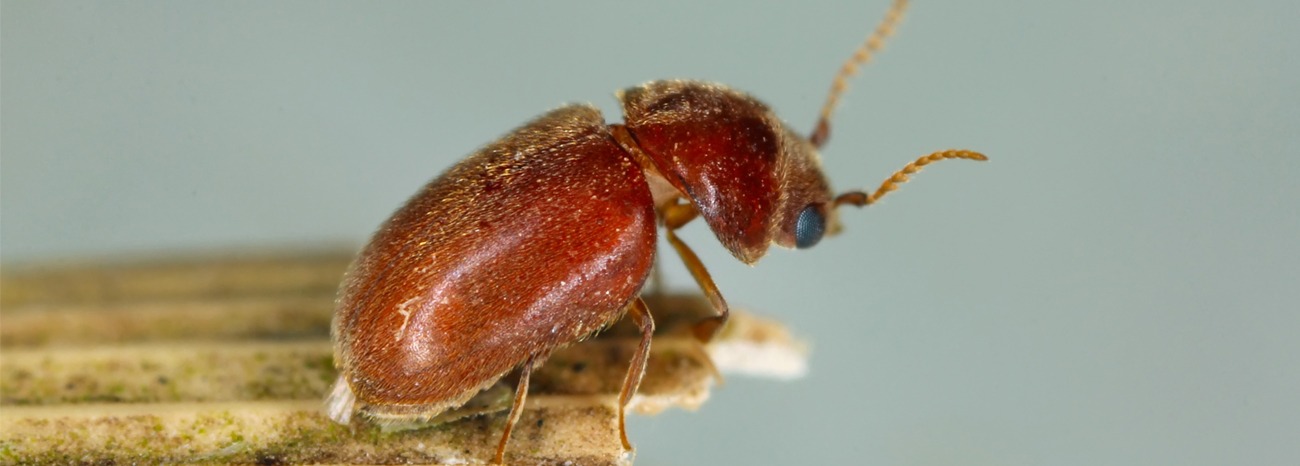
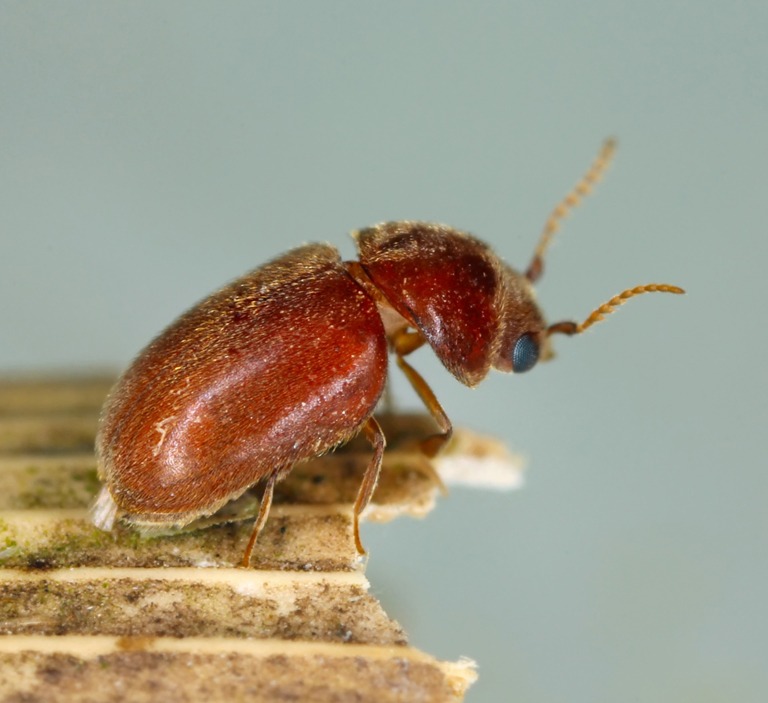
Pantry beetles are tiny brown or reddish-brown beetles that infest stored dry foods in kitchens and pantries. The most common species in Pennsylvania homes include the cigarette beetle (also called the tobacco beetle or cigar beetle), the drugstore beetle, and the sawtoothed and merchant grain beetles. They infest cereal, flour, spices, dried fruit, pet food, birdseed, dried herbs, and, in the case of the cigarette beetle, tobacco. Most pantry beetles are harmless to humans and pets in the sense that they don’t bite, sting, or transmit disease, but they contaminate the food they infest and their presence means at least one food product in your home needs to be discarded. Moyer Indoor Outdoor’s pest control team has treated pantry beetle infestations across Bucks, Montgomery, Chester, Lehigh, and Delaware counties in Pennsylvania since 1869. This guide walks through how to identify the species you’re dealing with, whether they’re harmful, how they got into your home, and how to get rid of them for good.
What are pantry beetles?
Pantry beetles (sometimes called pantry pests, stored product pests, or cupboard beetles) are a group of small beetle species that share one thing in common: they infest stored dry foods. They’re not one species but rather several distinct species that get grouped together because they behave similarly and require similar treatment.
The most common pantry beetles in Pennsylvania homes are:
- Cigarette beetle (Lasioderma serricorne), also called the tobacco beetle or cigar beetle
- Drugstore beetle (Stegobium paniceum)
- Sawtoothed grain beetle (Oryzaephilus surinamensis) and merchant grain beetle (Oryzaephilus mercator), which are nearly identical
- Red flour beetle (Tribolium castaneum) and confused flour beetle (Tribolium confusum), which are also nearly identical
- Warehouse beetle (Trogoderma variabile)
Weevils (rice weevil, granary weevil, maize weevil) are a related group of stored food pests that homeowners often lump in with pantry beetles. Technically weevils are a distinct family of beetles with elongated snouts, and they behave differently enough that they warrant separate coverage. If you see small bugs in your rice, whole grains, or dried beans and they have a visible elongated snout, you may be dealing with weevils rather than pantry beetles.
Common pantry beetle species in your home
Cigarette beetle (also called tobacco beetle or cigar beetle)
The cigarette beetle is the most common pantry beetle Moyer’s team encounters in Pennsylvania homes. Adults are 2 to 3 mm long (about one-tenth of an inch), oval, stout, and reddish-yellow to brownish-red. The most distinctive identification feature is the shape of the body when viewed from the side: the head is bent down at nearly a right angle to the body, giving the beetle a humped appearance. The wing covers are smooth (not striated), and the antennae are serrated rather than clubbed.
These identification details are drawn from Penn State Extension’s cigarette beetle fact sheet, which also notes the species is common across Pennsylvania and confused most often with the drugstore beetle.
Despite the misleading name, cigarette beetles don’t only infest tobacco. They feed on a wide range of dry goods including cereal, dried fruit, seeds, flour, spices, dried herbs, dried flowers, dried pet foods, and even old rodent baits. In Pennsylvania, dried herbs and spices are among their most common food sources, more so than tobacco. Where the tobacco name matters: if you smoke or store cigars, cigarette beetles are the pest most likely to be found inside stored tobacco products, especially in humid conditions.
Cigarette beetle life cycle: adult females lay 10 to 100 eggs on or near food sources. Eggs hatch within a few days into cream-colored, cylindrical larvae covered in tiny hairs. Larvae feed on the food source for two to five weeks, molting several times. The pupa stage lasts eight to ten days, during which the larva spins a cocoon and transforms into an adult. Adults live two to four weeks. The entire life cycle takes four to eight weeks in ideal conditions (around 80 degrees Fahrenheit and high humidity). Cooler or drier conditions slow development significantly.
Drugstore beetle
The drugstore beetle is a close relative of the cigarette beetle and is easily confused with it. Both are about the same size (about one-tenth of an inch, or 2 to 3 mm), both are light brown to reddish-brown, and both have a humped appearance.
Penn State Extension notes three features that distinguish the two species:
- The drugstore beetle’s body is more elongated in proportion to its width; the cigarette beetle’s body is more oval and stout
- The drugstore beetle has visible longitudinal striations (grooves) running down the length of its wing covers; the cigarette beetle’s wing covers are smooth
- The drugstore beetle’s antennae end in a distinct three-segmented club; the cigarette beetle’s antennae are serrated (comb-like) along their length
Drugstore beetles are also active fliers with rapid, skittering movement. They get their name from feeding on stored pharmaceuticals, but like cigarette beetles they’ll infest a wide range of stored foods including flour, cereal, spices, seeds, dried pet food, and even books, leather, and dried plant materials. If you can’t tell the two species apart, the good news is treatment approach is the same for both.
Sawtoothed grain beetle and merchant grain beetle
These two species look nearly identical and behave almost identically, so they’re commonly discussed together. Both are 1/10 inch (about 2.5 to 3 mm) long, flattened, and reddish-brown.
According to Penn State Extension, the most distinctive identification feature is the six sawtooth-like projections on each side of the thorax (the middle body segment behind the head). The wing covers are longitudinally grooved.
The two species differ in three ways:
- The sawtoothed grain beetle has a temple area (behind the eye) about half as long as the eye itself; the merchant grain beetle’s temple area is much smaller
- The sawtoothed grain beetle cannot fly; the merchant grain beetle can and does
- The sawtoothed grain beetle prefers cereal-based products (oats, flour, breakfast cereals); the merchant grain beetle prefers nuts, seeds, and dried fruit
Both species are extremely small and their flattened shape lets them slip into cracks in packaging and food storage containers that other pantry beetles cannot enter. Female grain beetles lay 40 to 285 eggs, and the life cycle takes about 30 to 45 days in warm conditions.
Red flour beetle and confused flour beetle
Both species are reddish-brown, about 3 to 4 mm long, and distinguishable from other pantry beetles by their larger size and less humped shape. They infest flour, cereal, dry cake mix, pasta, crackers, dried pet food, and processed grain products. Red flour beetles fly; confused flour beetles typically don’t. Both give off a foul-smelling secretion when disturbed, which can taint food they’ve been in contact with.
Warehouse beetle
The warehouse beetle is a member of the dermestid family, dark with mottled tan patterns, and about 3 mm long. Larvae have distinctive tufts of bristly hair that shed as they develop, and the shed hairs can trigger asthma-like symptoms in sensitive individuals. Warehouse beetles infest a wide range of dry foods including cereal, flour, spices, dried meat, nuts, and pet food.
Are pantry beetles harmful to humans or pets?
The short answer: pantry beetles don’t bite, sting, or transmit disease to humans or pets. They are considered nuisance pests. If you accidentally eat food that contained pantry beetles, larvae, or eggs (which is essentially guaranteed to happen occasionally to anyone with a stocked pantry, whether they realize it or not), there is no known health risk. This is part of why FDA regulations for dry foods permit small quantities of insect fragments per unit weight [ADD LINK: https://www.fda.gov/food/current-good-manufacturing-practices-cgmps-food-and-dietary-supplements/food-defect-levels-handbook]; complete elimination in agricultural and processed food supply chains is not realistic.
That said, pantry beetle infestations are a real problem for three reasons:
- Contamination and waste. Food that pantry beetles have infested has to be discarded, which can add up to significant grocery cost over the life of an infestation.
- Warehouse beetle allergen risk. The one exception to the general harmlessness rule is the warehouse beetle. Larvae shed bristly hairs during development, and those hairs can trigger asthma-like symptoms in sensitive individuals if inhaled or ingested. This is a documented health risk unique to this species.
- Contaminated food is a quality issue. Even if the beetles themselves are harmless, the presence of live insects, larvae, cast skins, fecal pellets, and beetle-associated fungi in food renders it unfit to eat by any reasonable standard.
So while the answer to “are pantry beetles dangerous to my family?” is essentially no, the answer to “should I take them seriously and address the infestation?” is yes. They will multiply, spread to other food products, and become progressively more expensive and difficult to eliminate the longer they’re left alone.
Do pantry beetles fly?
Whether pantry beetles fly depends on the species:
- Cigarette beetles: Yes. Adults fly and are often mistaken for tiny flying gnats or small moths, especially when they emerge from an infested food package.
- Drugstore beetles: Yes. Drugstore beetles are strong fliers with distinctively rapid, skittering movement.
- Sawtoothed grain beetles: No. Sawtoothed grain beetles cannot fly.
- Merchant grain beetles: Yes. Merchant grain beetles have well-developed wings and are capable fliers.
- Red flour beetles: Yes. Red flour beetles fly.
- Confused flour beetles: No, typically. Confused flour beetles have wings but rarely if ever fly.
- Warehouse beetles: Yes. Warehouse beetles fly.
If you’re seeing tiny flying beetles in your kitchen or near windows and lights, cigarette beetles and drugstore beetles are the most likely suspects. Adult beetles are attracted to light and often congregate near windows, ceiling fixtures, and lamps, especially in the evening. This is often the first sign that a pantry infestation exists somewhere in the home; the adults have emerged from an infested food package and are looking for either more food or a way outside.
Signs of a pantry beetle infestation
Common signs that a pantry beetle infestation is underway:
Live beetles crawling in or on stored food, in cupboards, or near windows and lights. This is the most obvious sign but often not the first. By the time adults are visible, larvae have usually been developing in one or more food products for weeks.
Small round holes in food packaging. Cigarette beetles and drugstore beetles chew through cardboard, plastic film, cellophane, and paper packaging to enter or escape. Look for tiny holes in flour bags, cereal boxes, spice containers, and pet food bags.
Flour, meal, or cereal residue near packaging. Small piles or trails of food residue outside a package indicate insects are moving in and out through packaging holes.
Larvae in food. Cream-colored, C-shaped or cylindrical larvae in flour, cereal, spices, dried herbs, or grain products. Cigarette beetle larvae are cream-colored, cylindrical, and covered in fine hairs. Larvae are usually harder to spot than adults and easier to overlook when they’re in similarly-colored food.
Cast skins, pupal cases, and fecal pellets. As pantry beetles develop through larva and pupa stages, they leave behind shed skins and pupal casings. In an established infestation, these may be more visible than the beetles themselves.
Musty or off odor in food. Infested food often develops a distinct musty smell as insect activity and associated microbial growth accumulate.
How do pantry beetles get in your home?
This is one of the more surprising facts about pantry beetles: they almost never arrive as a home invasion in the way ants or roaches do. They arrive inside food you’ve already bought.
Pantry beetle infestations typically start in agricultural production, grain storage, flour milling, or processed food manufacturing, where beetles or their eggs enter food products before packaging. Small quantities in packaged food are extremely common; commercial food processors use screening, temperature treatments, and pheromone traps to keep quantities below regulatory thresholds, but complete elimination in dry goods supply chains is not practical.
Once contaminated food arrives in your pantry, warm indoor temperatures and access to more food allow the population to grow. A single female cigarette beetle can lay 100 eggs on a single food source. If undisturbed for several weeks, that one contaminated bag of birdseed, flour, or dried herbs becomes an active colony that spreads to other stored food products in the same cupboard.
Common entry points for the initial contamination:
- Bulk-bin food products (loose flour, cereal, oats, dried fruit, spices)
- Packaged dry goods stored on grocery store shelves for extended periods
- Pet food (dry kibble, birdseed, aquarium fish food)
- Dried herbs, spices, and specialty ingredients (especially imported)
- Whole-grain products where processing hasn’t sterilized the grain
- Long-stored items in your own pantry (flour, seeds, or dried herbs that have been sitting for months to years)
A secondary route: pantry beetles can move between adjacent homes, especially in multi-unit buildings, by walking or flying through gaps in shared walls, under doors, or through utility penetrations. If a neighboring unit has an active infestation, adults sometimes migrate.
How to get rid of pantry beetles
Effective pantry beetle treatment requires locating the infested food, discarding it thoroughly, cleaning the affected space, and preventing recurrence. Spraying is not the primary approach; unlike ants or roaches, pantry beetles don’t establish colonies with a queen you can target, so the solution is source elimination.
Step 1: Find the source
Take everything out of the affected pantry, cupboard, or storage area. Inspect every dry-goods package individually, especially flour, cereal, oats, cornmeal, breadcrumbs, dried herbs and spices, tea, coffee, birdseed, dry pet food, and dried fruit. Look for live beetles, larvae, small holes in packaging, or food residue that suggests insect activity. Check inside spice jars, cake mix boxes, and even sealed cardboard packaging. Pantry beetles chew through paper, cardboard, and thin plastic, so a package that looks intact may still be infested.
For a magnified inspection of suspicious food, a flashlight and a magnifying glass help. In severe cases, you may need to inspect the food itself: sift flour and cornmeal, inspect rice grain-by-grain in a shallow tray, and check spice jars against a light source. Any food product with visible beetles, larvae, or residue should be discarded regardless of how new or expensive it is.
Step 2: Discard infested food
All infested items go directly into an outdoor trash receptacle, not into the kitchen trash. Leaving infested food in a kitchen trash bag allows the beetles to continue spreading. Double-bag if necessary to prevent adults from escaping the bag.
When in doubt, discard. The cost of throwing out marginal food products is much less than the cost of a persistent infestation. Freezing infested food for four to seven days at 0 degrees Fahrenheit kills adult and larval beetles, but most people would rather not eat food they know contained live insects, so discarding is the more common approach.
Step 3: Clean thoroughly
Empty and vacuum the affected pantry, cupboard, or shelf. Pay special attention to corners, cracks between shelves, gaps between the shelf and the wall, holes for adjustable shelf pegs, and any other harborage where flour, crumbs, or larvae may have collected. Vacuum thoroughly with a hose attachment and immediately empty the vacuum bag or canister into an outdoor trash receptacle.
After vacuuming, wipe down all surfaces with a soapy water solution. Avoid using strong chemical insecticide sprays inside a food storage area; the goal is physical removal of any remaining larvae, eggs, or food residue that could restart the infestation.
Step 4: Inspect adjacent areas
Pantry beetles spread from their initial food source outward. If you found the infestation in one cupboard, inspect all other food storage areas in your kitchen, plus any location where dry goods are stored (basement pantry, mud room shelves, garage storage). Check pet food bins, birdseed containers, and any decorative dried-plant arrangements (dried flowers can harbor cigarette beetles for months).
Step 5: Store remaining food in airtight containers
This is the most important preventive step. Transfer all dry goods from paper, cardboard, and thin plastic packaging into airtight glass or hard-plastic containers with tight-fitting lids. Even if a food product is beetle-free now, it may become contaminated later or may already contain trace amounts of eggs that hatch weeks later. Airtight storage prevents any latent contamination from spreading to other food products and prevents adult beetles from re-entering.
Step 6: Monitor for four to six weeks
Pantry beetle life cycles can extend six to eight weeks, and eggs already laid in food you’ve kept can hatch after the initial cleanup. Watch for renewed activity for at least a month after the initial treatment. If you see new beetles, repeat the inspection process, and expand your search to food products you didn’t inspect the first time.
Step 7: If activity continues, call a professional
Persistent pantry beetle activity after thorough source elimination usually means one of three things: an infested food product was missed during inspection, the infestation has spread to a location outside the pantry (rodent bait stations, decorative dried plants, pet food elsewhere in the home, or bird nests in attic vents), or beetles are migrating in from a neighboring unit in multi-family housing. Professional pest control can identify sources you may not have thought to check and apply targeted treatments that don’t require you to empty the affected area repeatedly.
How to prevent pantry beetles
- Store all dry goods in airtight containers. Glass or hard-plastic containers with tight-fitting lids prevent both entry and spread. This is the single most effective prevention step.
- Buy dry goods in quantities you’ll use quickly. The longer food sits in storage, the more likely a small amount of initial contamination is to develop into a visible infestation. Rotate stock and use older packages first.
- Inspect food packaging before purchase. Look for small holes, damaged corners, or leaking product. Avoid purchasing damaged packaging, especially for grain products, flour, and dried herbs.
- Clean up spills promptly. Flour, cornmeal, cereal, and cake mix spills that fall into cabinet cracks become breeding sites. Sanitize the spill area with soapy water rather than just wiping.
- Discard compromised food immediately. Don’t try to salvage food you’ve found beetles in. Remove it from the home.
- Store pet food and birdseed carefully. Kibble, birdseed, and other pet food is a common but overlooked pantry beetle source. Store in sealed containers, not the original bag.
- Freeze suspect items. New purchases of flour, cornmeal, dried herbs, and spices can be preventatively frozen for four to seven days at 0 degrees Fahrenheit to kill any potential eggs or larvae before storage.
- Consider pheromone monitoring traps. For homes with recurring pantry beetle problems, sticky traps baited with species-specific pheromones catch adult beetles and provide early warning of an active infestation.
- Clean the pantry seasonally. Empty the pantry once or twice a year, vacuum shelves and cracks, wipe down surfaces, and inspect stored goods. Penn State Extension recommends a full pantry cleanout as a routine part of spring cleaning.
When to call a professional
Most pantry beetle infestations can be resolved with DIY source elimination. Professional treatment becomes worth it when:
- You’ve done a thorough inspection and cleanup, transferred to airtight containers, and beetles are still appearing weeks later
- Multiple rooms or cabinets are affected
- You can’t find the source despite inspection
- You live in a multi-unit building and suspect beetles are migrating from a neighboring unit
- You’re dealing with a warehouse beetle infestation and have household members with asthma or respiratory sensitivity
- You’re preparing for a home sale or health inspection and need documented remediation
Moyer Indoor Outdoor’s licensed pest control technicians treat pantry beetle infestations across Bucks, Montgomery, Chester, Lehigh, and Delaware counties in Pennsylvania. Our team can identify the specific species you’re dealing with, locate hidden sources, apply targeted treatments that are safe for use in kitchens and pantries, and set up monitoring to prevent recurrence.
Call (215) 799-2010 or schedule an evaluation online.
Frequently asked questions
Are pantry beetles dangerous to humans?
No. Pantry beetles don’t bite, sting, or transmit disease. Accidentally eating food that contained beetles, larvae, or eggs is not a health risk. The one exception is the warehouse beetle: its larvae shed bristly hairs during development, and inhaling or ingesting those hairs can trigger asthma-like symptoms in sensitive individuals. All other pantry beetles are considered nuisance pests.
Are pantry beetles dangerous to pets?
No. Pets that eat pet food containing pantry beetles or larvae are not at risk. That said, you should still discard the infested pet food because the food will be off-quality and contaminated with insect fragments, cast skins, and fecal matter.
What are the tiny brown beetles in my pantry?
The most likely candidates are cigarette beetles (oval, humped, 2-3mm, smooth wing covers), drugstore beetles (elongated, humped, 2-3mm, striated wing covers), sawtoothed or merchant grain beetles (flat, 2-3mm, sawtooth projections on thorax), or red or confused flour beetles (larger at 3-4mm, less humped). If they’re in stored flour, cereal, spices, or dried herbs, and they’re small and brown, they’re almost certainly one of these species.
Do pantry beetles fly?
Some do, some don’t. Cigarette beetles, drugstore beetles, merchant grain beetles, red flour beetles, and warehouse beetles fly. Sawtoothed grain beetles and confused flour beetles do not. If you see tiny beetles near your windows, lights, or ceiling fixtures, you’re most likely looking at cigarette beetles or drugstore beetles that have emerged from an infested food package somewhere in your home.
Where do pantry beetles come from?
Almost always from food you’ve bought. Pantry beetle contamination usually begins during agricultural production, grain storage, milling, or food processing, and eggs or beetles are already present in packaged food when it reaches your home. Small quantities of insect fragments in dry food are common in the food supply chain and generally considered acceptable within regulatory limits. Once inside your pantry, contaminated food allows the population to grow and spread to other stored items.
How do I get rid of cigarette beetles?
Locate and discard the infested food product (or products), thoroughly vacuum and clean the affected pantry or cupboard, transfer remaining dry goods to airtight containers, and monitor for four to six weeks. Cigarette beetles emerge from an infested food source, so identifying and eliminating that source is essential. Spraying insecticide in a pantry is not the right approach and may contaminate food storage areas.
What’s the difference between a cigarette beetle and a drugstore beetle?
They’re closely related and look similar at a glance. Three distinguishing features: the cigarette beetle is more oval and stout while the drugstore beetle is more elongated; the cigarette beetle has smooth wing covers while the drugstore beetle has visible longitudinal grooves on its wing covers; and the cigarette beetle has serrated (comb-like) antennae while the drugstore beetle has three-segmented clubbed antennae. Treatment is essentially the same for both species, so precise identification matters more for identification purposes than for control.
How long does a pantry beetle infestation last?
With thorough source elimination (finding and discarding all infested food, cleaning the affected space, transferring remaining food to airtight containers), most infestations are resolved within four to six weeks. Persistent activity beyond that time usually means an infested food source was missed during inspection. Untreated infestations can persist indefinitely because pantry beetles reproduce as long as food is available.
Can I keep food that has pantry beetles in it?
Technically yes: sifting flour, freezing food for four to seven days at 0 degrees Fahrenheit, or heating in a 130-degree oven for 30 minutes kills all life stages. But most people would rather not eat food they know contained live insects, and the emotional and quality issues typically outweigh the food-cost savings. Discarding is the standard recommendation.
Do pantry beetles come from outside?
Rarely. Pantry beetles are primarily indoor pests that arrive with food, then reproduce indoors. Some species can migrate from outdoor food sources like grain silos, bird nests, or squirrel food caches, but for the average household infestation, the source is almost always food that came in through the grocery bag.
Should I use pantry pest traps?
Pheromone-baited sticky traps can help monitor for pantry beetle activity and catch some adult males, but they’re not sufficient as a standalone treatment. Traps confirm you have a problem and give some sense of intensity, but they don’t eliminate the source infestation. Use traps as an early-warning and monitoring tool alongside source elimination, not as a replacement for it.